
Explore key trends and the future outlook of automation in the finance industry, including AI, RPA, use cases, benefits, and challenges.
Automation in the Finance Industry: Trends and Future Outlook
Automation is reshaping the finance industry at a rapid pace. Banks, insurance companies, investment firms, and fintech startups are using advanced technologies to improve speed, accuracy, and customer experience.
In 2026, automation is no longer limited to simple tasks. It now includes artificial intelligence (AI), robotic process automation (RPA), machine learning, and advanced analytics. These technologies are transforming how financial services operate and grow.
What Does Automation in the Finance Industry Mean?
Automation in the finance industry refers to the use of technology to perform financial tasks with minimal human intervention. It includes tools such as robotic process automation, AI-powered systems, and workflow software that handle repetitive and complex processes.
For example, automation can process transactions, generate financial reports, verify customer identities, and monitor suspicious activities. Instead of relying fully on manual work, financial institutions use digital systems to improve efficiency and reduce errors.
This shift allows finance teams to focus more on strategy, risk management, and customer relationships rather than routine administrative work.
Why Is Automation Becoming Essential in Finance?
Automation has become essential because financial institutions face high transaction volumes, strict regulations, and increasing customer expectations. Manual processes are slower and more prone to mistakes.
Customers now expect instant payments, real-time account updates, and quick loan approvals. Automation helps deliver these services efficiently. It also reduces operational costs and ensures consistent compliance with regulatory requirements.
In a competitive digital environment, financial organizations that fail to automate risk falling behind more agile fintech competitors.
What Are the Key Trends in Finance Automation in 2026?
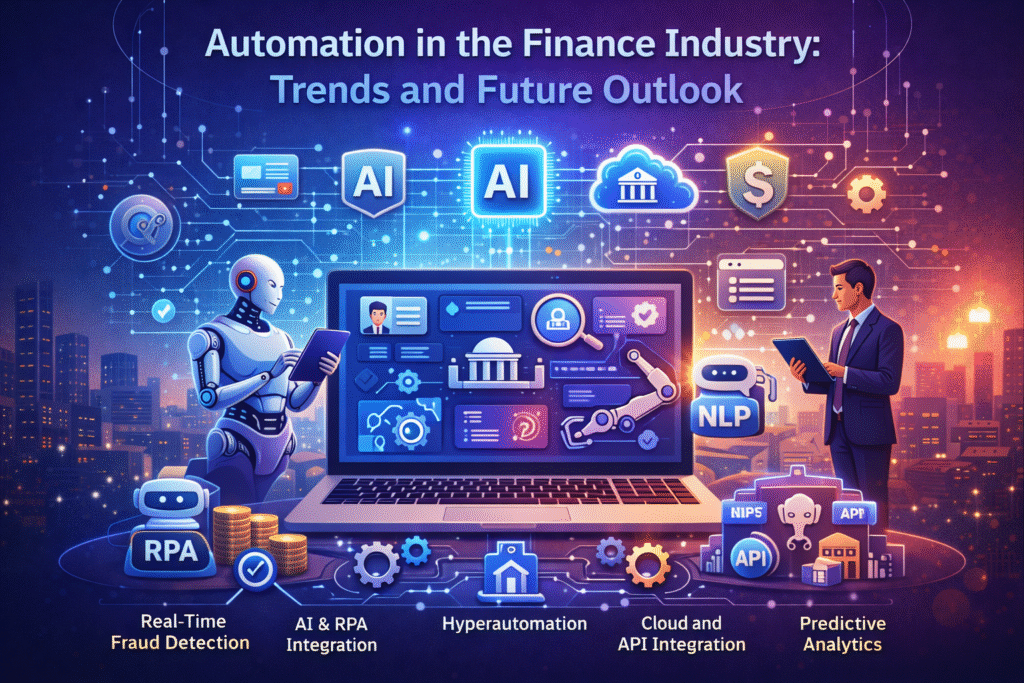
In 2026, several major trends are shaping automation in the finance sector. One key trend is the integration of AI with RPA, often called intelligent automation. This allows systems to analyze data, learn patterns, and support decision-making.
Another important trend is hyperautomation, where multiple processes across departments are automated end to end. Cloud-based automation platforms are also growing, enabling faster deployment and scalability.
Real-time fraud detection, AI-driven credit scoring, and predictive analytics are becoming more advanced. Open banking and API-based systems are making it easier for institutions to connect automation tools with core financial systems.
These trends show that automation is moving from basic task management to strategic transformation.
How Is Automation Used Across Different Financial Sectors?
Automation is applied in many areas of the finance industry. In banking, it is used for customer onboarding, transaction monitoring, loan processing, and compliance reporting.
In insurance, automation supports claims processing, policy management, and risk assessment. Investment firms use automation for trade reconciliation, portfolio analysis, and regulatory documentation.
Accounting and finance departments in corporations also rely on automation for accounts payable, accounts receivable, and financial forecasting. Across sectors, the goal remains the same: increase efficiency and accuracy while reducing operational risk.
What Are the Main Benefits of Finance Automation?
Finance automation offers several important benefits. It reduces manual errors, lowers operational costs, and improves processing speed. Automated systems can operate continuously, ensuring faster service delivery.
Automation also improves data accuracy and transparency. Real-time reporting allows better decision-making and risk management. For customers, this means faster transactions and improved service reliability.
Another key benefit is scalability. As transaction volumes grow, automated systems can handle increased demand without significant increases in staffing costs.
What Challenges Does the Finance Industry Face with Automation?
Despite its advantages, automation in finance presents challenges. One major issue is integrating modern automation tools with legacy systems that many financial institutions still use.
Data security is another critical concern. Financial institutions must protect sensitive information and comply with strict data privacy regulations. AI-driven decisions must also be transparent and explainable to regulators.
There is also the challenge of workforce adaptation. Employees may need new skills to work alongside automated systems. Successful organizations invest in training and change management to ensure smooth adoption.
What Is the Future Outlook for Automation in Finance?
The future of automation in finance includes deeper AI integration, more predictive analytics, and fully digital workflows. Financial institutions are moving toward connected ecosystems where processes are automated from start to finish.
We can expect smarter fraud detection models, automated financial advisory services, and real-time compliance monitoring. Generative AI may also support financial reporting and customer communication.
Automation will not replace human expertise but will enhance it. The future finance industry will combine machine efficiency with human judgment to deliver secure, efficient, and customer-focused services.
FAQs
1. Is automation the same as AI in finance?
No. Automation includes various technologies, while AI is one component that enables learning and advanced analysis.
2. Can small financial firms use automation?
Yes. Many automation solutions are scalable and suitable for small banks, fintech startups, and accounting firms.
3. Does automation reduce finance jobs?
Automation reduces repetitive tasks but often creates new roles focused on analysis, oversight, and technology management.
4. Is finance automation secure?
It can be secure when combined with strong cybersecurity measures, encryption, and regulatory compliance.
5. Why is automation critical for the future of finance?
Automation ensures speed, accuracy, compliance, and scalability, which are essential in a digital and highly competitive financial environment.