
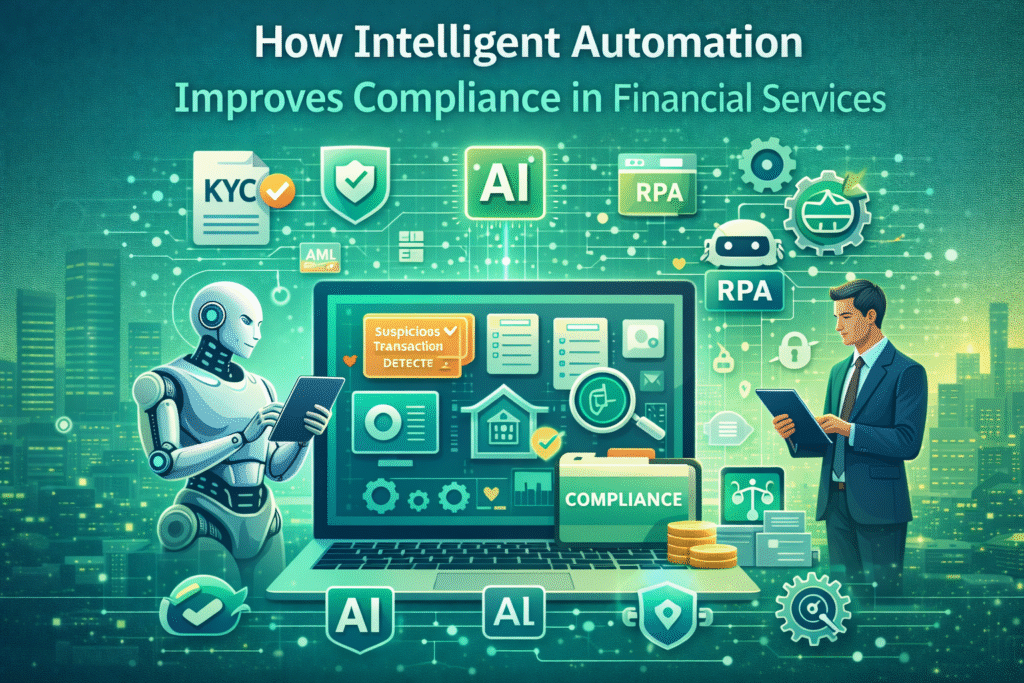
Learn how intelligent automation improves compliance in financial services through AI, RPA, AML monitoring, and real-time risk management.
How Intelligent Automation Improves Compliance in Financial Services
Compliance is one of the biggest challenges in financial services. Banks, insurance companies, and fintech firms must follow strict regulations related to data privacy, anti-money laundering (AML), fraud prevention, and reporting.
Manual compliance processes are slow and prone to human error. Intelligent automation is helping financial institutions manage regulatory requirements more efficiently and accurately. By combining AI, robotic process automation (RPA), and analytics, organizations can reduce risk and improve transparency.
What Is Intelligent Automation in Financial Compliance?
Intelligent automation in financial compliance refers to the use of AI, machine learning, and robotic process automation to manage regulatory tasks automatically. It helps institutions monitor transactions, verify customer identities, and generate compliance reports with minimal manual intervention.
Instead of relying only on human teams to review documents and transactions, automated systems analyze large volumes of data in real time. These systems can detect unusual patterns, flag suspicious activities, and ensure regulatory rules are applied consistently.
This approach strengthens internal controls and reduces the risk of non-compliance.
Why Is Compliance So Complex in Financial Services?
Compliance in financial services is complex because regulations vary across countries, frequently change, and require detailed documentation. Institutions must follow rules related to Know Your Customer (KYC), Anti-Money Laundering (AML), data protection, and financial reporting.
Manual compliance processes require reviewing thousands of transactions and documents. Even small errors can lead to heavy fines or reputational damage. As transaction volumes grow in digital banking, the burden on compliance teams increases.
Intelligent automation helps manage this complexity by handling repetitive tasks and continuously monitoring regulatory requirements.
How Does Intelligent Automation Improve AML and KYC Processes?
Intelligent automation improves AML and KYC by automatically verifying customer identities, screening against watchlists, and monitoring transactions for suspicious behavior. AI models analyze patterns and detect anomalies that may indicate fraud or money laundering.
For example, during customer onboarding, automated systems can extract information from identity documents, cross-check databases, and assess risk levels instantly. In transaction monitoring, AI tools review large volumes of payments in real time and flag unusual activity.
By reducing manual reviews and improving accuracy, automation strengthens compliance while speeding up customer onboarding.
Can Intelligent Automation Reduce Compliance Costs?
Yes, intelligent automation reduces compliance costs by minimizing manual labor, lowering error rates, and speeding up reporting processes. Financial institutions spend significant resources on compliance teams and regulatory documentation.
With RPA bots generating reports automatically and AI systems monitoring transactions 24/7, organizations can reduce repetitive workload. This does not eliminate compliance staff but allows them to focus on complex investigations and strategic oversight.
Over time, automation improves operational efficiency and reduces the financial impact of regulatory penalties.
How Does Automation Support Regulatory Reporting?
Intelligent automation supports regulatory reporting by collecting, organizing, and validating data automatically. It ensures that required information is submitted accurately and on time.
For example, automated systems can pull data from multiple internal systems, compile compliance reports, and generate audit trails. This reduces manual data entry and the risk of inconsistencies.
Built-in tracking mechanisms also provide transparency. During audits, institutions can quickly demonstrate how data was processed and how compliance decisions were made.
What Are the Risks of Using Automation in Compliance?
While intelligent automation improves compliance, it also introduces certain risks. One key concern is over-reliance on technology. If systems are not properly monitored, errors or biases in AI models may go unnoticed.
Data privacy and cybersecurity are also critical. Compliance systems handle sensitive personal and financial information. Strong encryption, access controls, and regular system updates are essential.
Another challenge is explainability. Regulators increasingly require that AI-driven decisions be transparent. Financial institutions must ensure automated processes can be audited and understood.
What Is the Future of Compliance Automation?
The future of compliance automation includes more advanced AI models, real-time risk assessment, and integrated RegTech platforms. Financial institutions are moving toward proactive compliance rather than reactive reporting.
In the coming years, automation will continuously monitor regulatory updates and adjust internal rules automatically. Predictive analytics may help identify potential compliance risks before they become violations.
Instead of replacing compliance professionals, intelligent automation will support them with faster analysis, deeper insights, and improved accuracy. The result will be a more secure and transparent financial system.
FAQs
1. Is intelligent automation the same as RegTech?
RegTech refers to technology designed specifically for regulatory compliance. Intelligent automation is often a core component of RegTech solutions.
2. Can automation fully replace compliance teams?
No. Automation supports compliance teams but human oversight remains essential for complex cases and strategic decisions.
3. How does automation help with AML monitoring?
It analyzes transactions in real time, detects suspicious patterns, and generates alerts for further investigation.
4. Is compliance automation secure?
It can be secure when institutions use strong cybersecurity measures, encryption, and regulatory best practices.
5. Why is automation important for financial compliance in 2026?
Regulations are increasing in complexity. Automation ensures faster monitoring, accurate reporting, and reduced compliance risk.